This is probably one of the most frequent questions I get asked. And honestly, it’s no wonder, because brands make it super confusing. The two words ‘short’ and ‘petite’ get thrown around as though they mean exactly the same thing, but they don’t.
Short and petite offerings are two very different things, and it’s important you know the difference. It might be the exact reason you still feel you can’t find clothes that fit your body properly. Remember, it’s never your body, it’s the clothes!
So in this post I’m going to break it all down. What short and petite really mean, why brands so often choose short lengths instead of proper petite fits, and exactly what you should be looking for in a genuine petite piece. By the end you’ll know exactly what to check when you’re trying things on, so you can stop buying clothes that don’t fit properly.
What “short” actually means?

When a brand offers a “short” length, all they have done is taken their regular garment and shortened the hem. That’s it. Just chopped off a couple of inches, usually between 2 and 3″, and called it short.
You’ll see it mostly on jeans and trousers, but plenty of brands do it on skirts, dresses and jumpsuits too. It’s an easy way to tick the inclusive sizing box, but it means that NOTHING else gets adjusted.
Taking two or three inches off a hem doesn’t make something petite, it just makes it shorter. And as we know, we don’t just have shorter legs, we have shorter proportions, so chopping a few inches off the bottom isn’t going to fix everything else. The shoulder seam stays where it was. The armhole stays the same depth. The bust darts still point at the same spot. The waist seam hasn’t been touched. The rise is unchanged and the sleeves are still the length they always were, just to name a few.
A short length can genuinely be useful though, and I don’t want to write it off completely. If you know what you’re looking for and how to check whether an item actually fits you correctly, this can still be an option.
So why do so many brands go down the short route?
Simply put, it’s because it’s cheap and it’s easy to do, and I say that as someone with a fashion degree and twenty five years in the industry. I know how a pattern gets created, so I know exactly what’s involved in doing this properly.
To make a genuinely petite garment, a brand has to create a whole new pattern block. Every piece re-drafted, re-graded across the size range, sampled, fitted on an actual petite model, then corrected. It’s a real investment of time and money.
A short length costs them almost nothing by comparison. They take the pattern they’ve already got, shorten it at the hem, and the job’s done. Same garment, slightly shorter.
What “petite” ACTUALLY means

A petite item, however, is a garment that has been adjusted across the whole range of petite proportions, not just the length. It’s been cut from a brand new block, which means every single measurement has been reconsidered for a shorter frame before the garment was ever made. And that’s the bit people don’t realise, petite isn’t really about length at all, it’s about where everything sits on your body.
So here’s my Petite Fit Checklist, everything that should truly have been considered and adjusted for a proper petite fit:
1. Inseam / Length

The most common alteration for a petite fit, this is the overall length of a garment. For trousers / jeans it’s the measurement from the crotch to the hem. This will be different for all petites and will depend on the style of the garment. The same goes for overall length on everything else, so nape to hem on dresses and coats, and waist to hem on skirts.
2. The rise
One of the reasons shorter lengths don’t always work, because taking up a hem doesn’t change the rise of a pair of jeans or trousers. It’s the distance from the crotch seam to the waistband, it’s the reason you might often find waistbands coming up towards your bust line, or the back of the jeans gapping, because our rise won’t be the same as a woman who’s 5’7″. It’s one I hardly ever see adjusted.
3. Shoulder width
Measured across the back from one shoulder point to the other. Ours are narrower, so the seam needs bringing in to sit on the edge of our shoulders instead of halfway down our arms. If this hasn’t been adjusted, it’s often the reason things constantly fall off our shoulders.
4. Armhole depth
Measured from the shoulder point down to your underarm, and it’s what sets how high the armhole sits. If it’s too deep, you can’t lift your arm without the whole garment coming up with you.
5. Shoulder depth

Measured from the bottom of your neck to the edge of your shoulder line. This is the one I struggle with the most, as my shoulders are one of my most petite areas, and it’s my most common reason why something doesn’t fit me.
6. Sleeve length

Such a common issue for us petites. We’ve all been there, rolling up our sleeves just so they sit properly, but these should be adjusted too. It doesn’t matter whether the sleeve is short, three quarter or full length, our arms won’t be the same length, so they need readjusting.
7. Neckline width
This is how far the neckline sits out towards each shoulder. If it hasn’t been narrowed, a wide neck will slide straight off you. Think about men’s shirts, which are sold by collar size because everyone’s neck is different. Ours are different too, we just never get offered the same thing.
8. Neckline depth

One of the most important for us petites, but one that so often gets overlooked. This is the depth from the shoulder line down to the lowest point of the neckline. If it hasn’t been adjusted, necklines often come down to our belly button and we end up flashing our underwear to everyone!
9. Neck to waist length

A petite torso means our waistline will be higher, so this needs raising too. It’s measured from the nape of your neck down to your natural waist, and it’s usually the biggest culprit behind why dungarees and jumpsuits look odd on us, because that line is sitting far lower than where it should be.
10. Bust points
Many garments have bust points such as darts, seams or shaping, and these need placing at the fullest part of your bust. If they’re not, it’ll feel tight and uncomfortable across the bust. This one is really important for women with a fuller bust, and it’s the reason clothes can somehow feel too big and too tight at the same time.
11. Knee placement
This is the one NO ONE ever talks about. On trousers and jeans, every pattern has a knee placement, and it’s usually the narrowest point of the leg, unless it’s a wide leg. It’s what informs where a flare, a barrel or a bootleg shape starts to open out. It’s also one of the reasons short lengths often don’t often solve the problem of proportions. They might be shorter, but the shape will be completely off because the knee placement hasn’t moved up with the hem.
12. The back yoke on jeans
The yoke is the panel on the back of your jeans under the waistband. The depth of this panel is the number one reason a pair of jeans might gap on you, because it’s too long for our petite torso and sits in the dip of the back. It’s also a feature I see rarely adjusted.
13. The scale and placement of details
This one isn’t directly about the fit, but it has a lot to do with how the garment looks and feels overall, and it’s sometimes the reason why even when something seems to fit, it just doesn’t feel right. It’s the scale of the details, so the size of the patch pockets on the back of jeans, the width of a wide leg trouser, or where the buttons are placed, because ours need to be closer together. It’s what makes the final fit come together.
That’s A LOT of different proportions to consider and a short length does just ONE of them.
How to use this to find clothes that actually fit
Start with the listing, but be cautious

There are no laws about how brands can use the words short or petite. Nobody’s checking, so there’s nothing stopping a brand using either word however they like, which is one of the many reasons shopping as a petite is so hard.
That said, most brands follow a rough pattern. Short, extra short, or a change in the inseam usually means they’ve only adjusted the length, while petite does tend to mean they’ve adjusted more than the length. But be careful, because more than the length doesn’t mean everything on the checklist, it just means more than one thing.
Always read what the brand says about their petite range, if the information is there at all. It gives you an idea of the type of adjustments they might have made. And have a closer look at the photographs and the model’s height. We know they don’t always give these, and when they do it might be a sample rather than the size you’re buying, but it’s a good place to start.
Work out which adjustments are important for your body.
The Petite Fit Checklist above might seem a bit overwhelming, but you don’t need to remember all of it. Not every garment will have them all to be considered, and not all of them will be applicable to you.
We’re all unique, so it’s important to know which areas are the most petite on you. For example, my shoulders and my neckline are my trickiest areas when I’m trying to find clothes that fit, whereas my inside leg and my rise aren’t so tricky. For someone else it might be the sleeve length or the bust points. So it’s really worth getting to know your body and your own proportions.
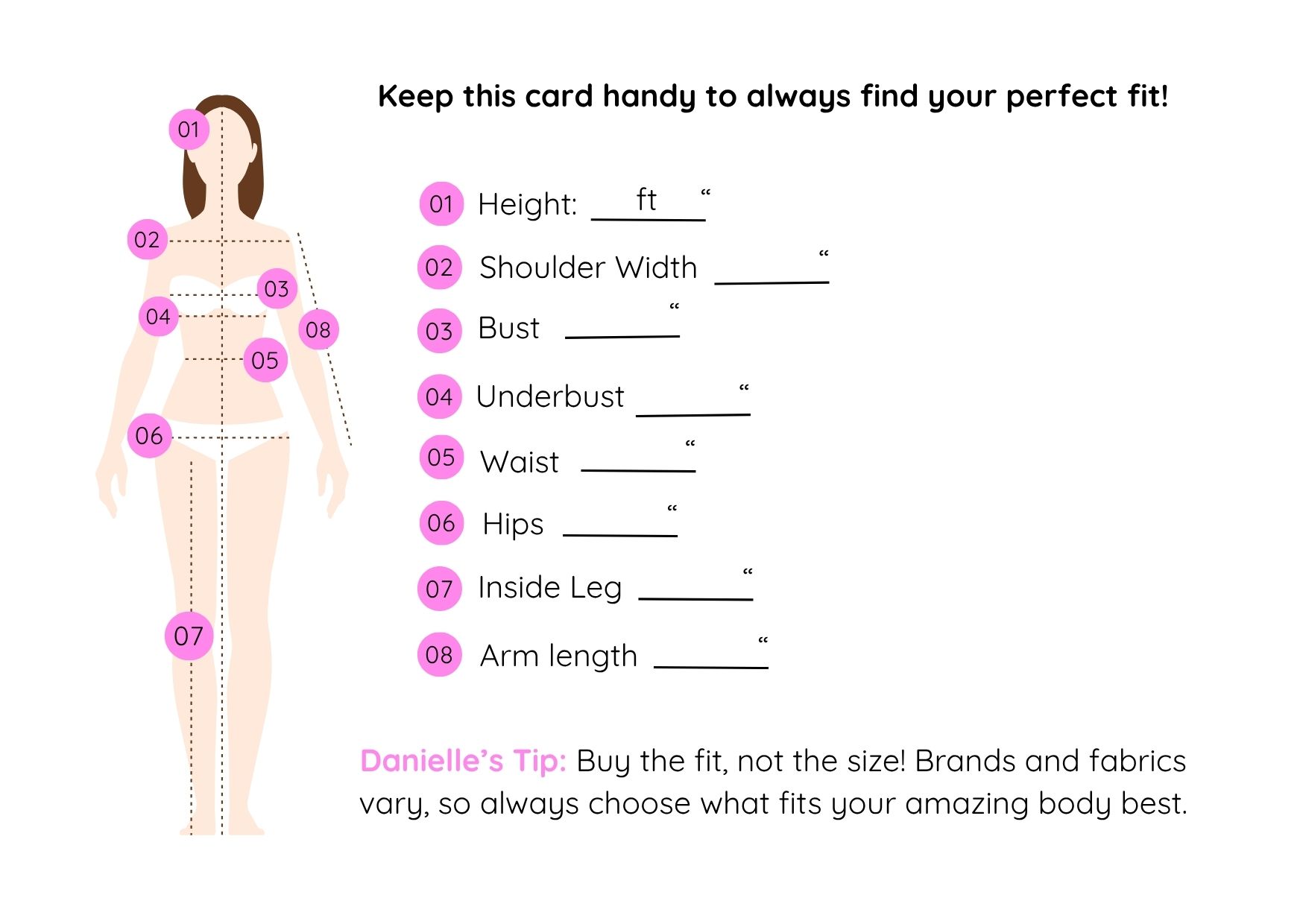
The place to start is your own measurements. I know this one can feel a bit scary, but honestly it’s so important if you want to find clothes that fit. Most women have no idea what their inside leg is, let alone their neck to waist. So if you haven’t already used my Perfect Fit Card, now’s a good time. You can download it and fill it in with all your own measurements, so they’re written down in one place ready for you to refer to. There’s a full guide to taking each measurement here: How to Take Your Measurements for the Perfect Fit and Fill Out Your Perfect Fit Card
Then here’s an extra exercise worth doing. Have a look through your wardrobe at the things you love and try them on. The reason you love them is probably because they fit you really well, so see what it is about them that works. And if you’ve got things in there you never wear and have never quite worked out why, pop those on too and see which areas aren’t fitting you. Once you know yours, you’ll spot them a mile off.

Make sure the clothes fit you, not the other way round

Here’s an exercise I’d really recommend. When you first try something on, do it without a mirror. Just put it on and see how it feels.
We can often feel whether something fits straight away, and it’s good to notice that before you get distracted by how it looks. Can you move your arms? Is anything pulling, or sitting somewhere it shouldn’t? Does it feel like it’s been made for your body? Your body will tell you a lot before your eyes get involved.
Then go to the mirror and go through the points that matter to you.
Is the shoulder seam sitting on the edge of your shoulder, or halfway down your arm? Can you lift your arms without the whole thing riding up with you? Is the waist seam where your waist actually is? Where’s the neckline landing on you? On trousers, where’s the waistband sitting, and where does the leg start to change shape compared to your actual knee?
So, to sum it all up
Short means they’ve taken up the hem. Petite should mean the whole garment has been reconsidered for a shorter frame. Those two things are not the same, and once you know the difference you’ll never look at a listing the same way again.
If you’ve got the choice between the two, always go petite over short. It won’t be perfect, but more will have been done for your body than just taking a couple of inches off the bottom.
Beyond that, the listing can only tell you so much. The real test is always trying it on, and now you know exactly what to look for when you do. Instead of standing there thinking something looks a bit off without being able to say why, you’ll be able to name it. The shoulder seam is too far out. The rise is too long. The flare is starting below my knee.
And that’s the bit I really want you to take away from this. When something doesn’t fit, it isn’t because there’s anything wrong with you or your body.
It was never your body. It’s the clothes.